How to Choose the Best House Air Purifier?
Choosing the best house air purifier begins with understanding your actual indoor air problems. Dust, pollen, smoke, pet dander, and cooking odors require different solutions. A purifier that works well in a bedroom may perform poorly in a large living room.
Dr. Richard Corsi, a respected indoor-air-quality researcher, offers a valuable warning: “There is no silver bullet when it comes to indoor air quality.” His point matters because air cleaning should support ventilation, source control, and regular housekeeping. It should not replace them. A reliable house air purifier can reduce airborne particles, but it cannot remove every pollutant from carpets, furniture, or damp walls.
Look for a verified HEPA filter when particle removal is the priority. Check the clean air delivery rate, room-size rating, energy use, and replacement-filter cost. Carbon filters may help with odors, but thin carbon sheets often have limited capacity. Noise also matters. A purifier running quietly beside a bed is more useful than a powerful model that stays switched off.
Small details reveal real performance. Notice whether the air outlet is blocked by a curtain. Check the filter after a dusty month. Listen for rattling at night. These observations can change your decision.
The perfect model may not exist. That is worth admitting. A practical choice balances measurable performance, maintenance effort, safety features, and household habits. This guide will compare those factors clearly, helping you choose a house air purifier with realistic expectations and stronger evidence.
Define Indoor Pollutants Using WHO’s PM2.5 Guideline of 5 µg/m³ Annually
How to Choose the Best House Air Purifier?
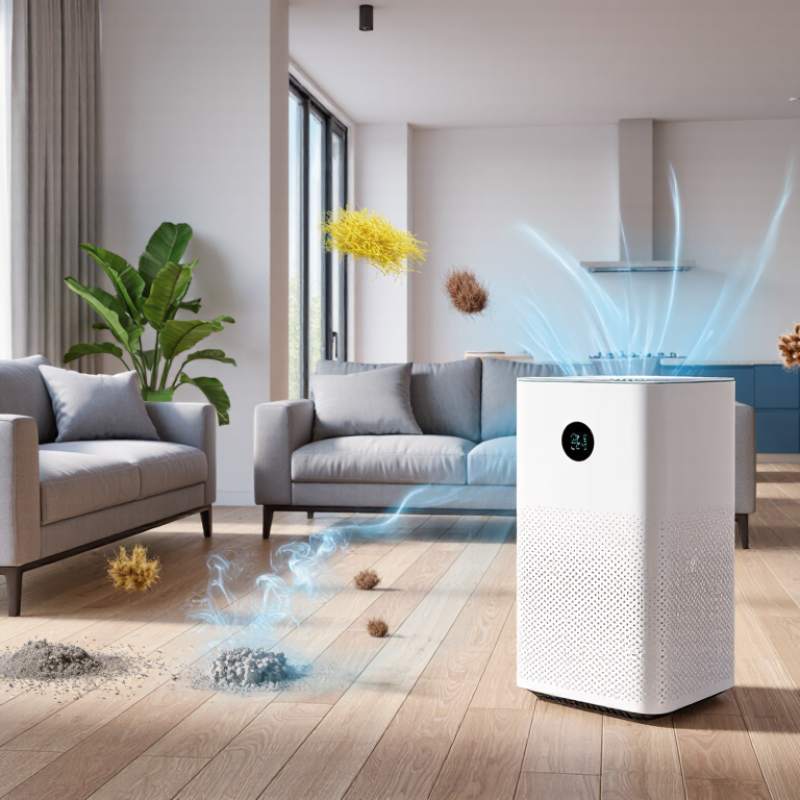
WHO’s annual guideline for PM2.5 is 5 µg/m³. This is a useful health reference, not a universal indoor legal limit. PM2.5 includes tiny particles from cooking, candles, tobacco smoke, traffic, and nearby construction. They can enter through open windows and remain suspended in still rooms. A purifier should reduce these particles, but it cannot solve every indoor pollution problem. Mold, strong odors, and volatile organic compounds may need moisture control, cleaning, or ventilation. Carbon monoxide requires a certified alarm, not an air purifier.
When choosing a unit, measure the room rather than trusting a large-room label. Match its clean air delivery rate to the space, and check whether replacement filters are available and affordable. A particle sensor can show changes after frying food or opening a window. However, low readings do not prove that every pollutant is gone. I once focused too heavily on dust reduction and ignored a damp cabinet behind furniture. That was a useful mistake. Air quality decisions need more than one measurement.
Tips:
Keep doors and windows consistent during testing. Run the purifier near the pollution source, but leave clear airflow around it. Clean pre-filters regularly. Compare readings at similar times. Do not treat the 5 µg/m³ target as a promise of perfect indoor air. It is a careful benchmark.
Match Room Size to CADR and ACH Ratings Under AHAM Standards
How to Choose the Best House Air Purifier?
Room size should guide your purifier choice, not attractive features alone. Measure the room first. Record its length, width, and ceiling height. Then calculate the volume. A 12-by-15-foot room with an 8-foot ceiling contains 1,440 cubic feet. Under the AHAM approach, aim for about 4.8 air changes per hour. This requires roughly 115 cubic feet per minute of clean air delivery. The formula is simple: CADR × 60 ÷ room volume equals ACH.
Compare the purifier’s tested CADR with your calculated requirement. Smoke CADR is often a practical reference because fine particles can remain suspended for hours. A larger CADR usually cleans the room faster, especially with doors opening or windows slightly cracked. Airflow matters more. For open-plan spaces, calculate the entire connected area. A purifier rated for one bedroom may struggle beside a kitchen and hallway.
I once underestimated a room by ignoring its high ceiling. The unit ran constantly, yet dust still settled on the desk. That mistake changed how I assess performance. Check whether the stated room size follows AHAM testing conditions, rather than trusting a vague marketing claim. Noise also affects real use. A powerful purifier left on low may clean less air than a quieter model running steadily. Filters, placement, and closed doors can alter ACH, so treat the rating as a tested baseline, not a guarantee.
Choose True HEPA Filtration Rated at 99.97% Efficiency for 0.3-Micron Particles
How to Choose the Best House Air Purifier?
Choose a purifier with True HEPA filtration rated at 99.97% efficiency for 0.3-micron particles. This benchmark comes from the U.S. Environmental Protection Agency’s Residential Air Cleaners: A Technical Summary. The 0.3-micron size is difficult to capture, so performance at this level offers a useful reference point. Smaller and larger particles may also be trapped efficiently through diffusion, interception, and impact.
Look beyond the filter label. The Association of Home Appliance Manufacturers recommends choosing a smoke CADR of at least two-thirds of the room’s floor area in square feet. A 180-square-foot bedroom, for example, needs roughly 120 smoke CADR. Higher airflow usually cleans faster, but it can also create more noise and use more electricity. Check the published noise rating before placing the unit beside your bed.
Real rooms are messier. Open doors, cooking, pets, and poor filter maintenance can reduce actual results. The EPA notes that portable air cleaners work best with source control and adequate ventilation. Keep the intake clear, replace filters according to measured loading, and avoid relying on vague “removes everything” claims. A purifier cannot correct mold caused by a leaking wall. That part is easy to forget. Also, the 99.97% figure describes filtration under test conditions, not guaranteed whole-room removal. Check CADR, room size, replacement costs, and independent test documentation together.
How to Choose the Best House Air Purifier?
Choose True HEPA filtration rated at 99.97% efficiency for 0.3-micron particles.
True HEPA filters are commonly rated to capture at least 99.97% of particles measuring 0.3 microns under the stated test conditions. The 0.3-micron size is used as a reference because it is near the most penetrating particle size for many mechanical filters; actual performance also depends on airflow, filter condition, sealing, and purifier design.
Compare Activated Carbon Capacity for Odors, VOCs, and Chemical Pollutants
How to Choose the Best House Air Purifier?
Activated carbon capacity matters when odors, VOCs, and chemical pollutants are your main concerns. A thin carbon sheet may reduce a smell briefly, then become saturated. Look for the carbon weight in grams, not vague claims such as “advanced filtration.” More carbon usually provides more adsorption space. A deeper carbon bed also improves contact time with moving air.
The U.S. Environmental Protection Agency reports that indoor pollutant levels can be two to five times higher than outdoor levels, and sometimes much higher. Its guidance also warns that gas-phase filters require enough sorbent material to work effectively. Remember, particle CADR ratings do not measure VOC removal. Industry particle tests, including AHAM methods, cannot replace carbon-capacity information. Ask for tested removal data, airflow conditions, and the estimated replacement interval. These details are often missing, and that should make you cautious.
Tips: Check whether the purifier lists carbon weight and bed depth. Avoid relying on odor alone. Some VOCs have little smell. A purifier with 500 grams of carbon may outperform one with a larger advertised airflow rate. However, carbon performance depends on humidity, chemical type, and room ventilation. I still find replacement timing difficult to predict in real homes. Cooking, renovation materials, and cleaning products can consume carbon much faster than laboratory tests suggest. EPA indoor-air guidance and manufacturer test reports should be read together, not separately.
Verify Noise, Energy Use, Filter Costs, and EPA Energy Star Certification
Choosing the best house air purifier requires more than comparing clean-air delivery rates. Noise, energy use, filter costs, and certification can change the real value over time. Check the sound rating at each fan speed, not only the quietest setting. A purifier may seem silent at night but become distracting on its highest setting.
Measure energy use with the wattage listed on the label or a plug-in meter. Running a 60-watt unit continuously uses about 525 kilowatt-hours yearly. Multiply that figure by your local electricity rate. Small differences can become noticeable on monthly bills. I once focused on purchase price and underestimated electricity costs. That was a useful mistake.
Filter expenses deserve equal attention. Confirm replacement intervals, total filter prices, and whether supplies remain easy to obtain. A cheap purifier can become expensive after several replacements. Inspect the filter area, too. Dust around a loose panel may suggest poor sealing, although one inspection cannot prove long-term performance.
For certification, search the official EPA ENERGY STAR database and match the exact model number. Do not trust a vague online badge or a seller’s wording. Certification can support efficiency claims, but it does not guarantee quiet operation or excellent filtration in every room. Compare the certified information with independent noise and energy measurements. Keep the receipt and record the installation date. Your household’s real usage may differ from laboratory testing.